Meet Bosnia and Herzegovina: Passion, history and a football culture with deep roots
As Toronto prepares to host matches, we’re profiling the countries that will take the pitch in the city.
When Bosnia and Herzegovina enters Toronto Stadium for its opening game against Canada, expect intensity from the first whistle. The team plays with conviction, backed by supporters who bring unwavering energy wherever the squad competes. Football holds a special place in the country’s sporting culture, with the national team being a source of pride at home and in Bosnian communities around the world.
Bosnia and Herzegovina made its first tournament appearance in 2014, a milestone moment for the country and its supporters. The team has developed a reputation for technical play, attacking creativity and moments of individual brilliance that can quickly shift the course of a match.
Bosnia and Herzegovina is known for its passionate supporters, who make their presence felt so strongly that they are effectively the team’s 12th player. When the team qualified for this year’s World Cup, 100,000 fans poured onto the streets of Sarajevo to celebrate all night. At games, they bring loud chants, flags and a level of emotion that reflects the strong connection between the national team and its fanbase. In Toronto, where there is a large Bosnian community, expect that energy to be turbocharged.
Beyond football, Bosnia and Herzegovina offers a rich mix of history, natural beauty and cultural influence shaped by East and West. Ottoman and Austro-Hungarian legacies remain visible in its architecture, cuisine and daily life, creating cities and landscapes that feel layered, distinctive and full of character.
For those inspired to experience Bosnia and Herzegovina beyond the tournament, Pearson offers connecting service to Sarajevo through major European hubs with airlines includingAir Serbia, SWISS, Air Canada, LOT Polish Airlines, Lufthansa, Turkish Airlines and SAS.
Here’s what the country has to offer beyond the beautiful game:
Sarajevo’s storied past
Sarajevo is one of Europe’s most fascinating capitals, where Ottoman bazaars, Austro-Hungarian architecture and modern city life exist side by side. A walk through the old town, Baščaršija, offers a glimpse into the city’s historic character, with cobbled streets, mosques, cafés and artisan shops that reflect centuries of cultural exchange.
The city is also known for its significance in world events, including its role leading up to the First World War. This is a place where local stories connect to global history.
Mostar and the iconic Stari Most
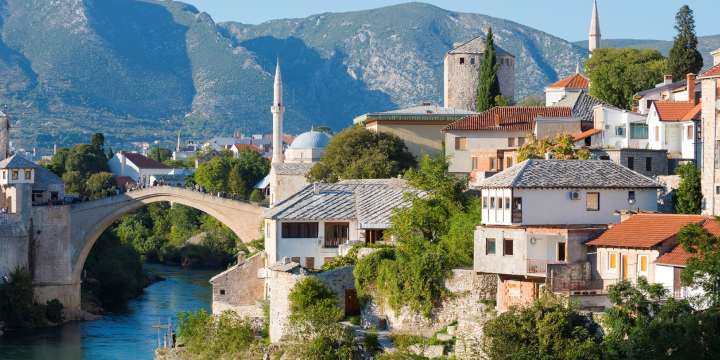
Few landmarks are as elegant as Mostar’s Stari Most, the 16th-century stone bridge that arches across the Neretva River. A UNESCO World Heritage Site, the bridge has become a symbol of the city and is one of the country’s most photographed locations.
Beyond the bridge itself, Mostar offers historic streets, riverside restaurants and dramatic scenery that make it one of Bosnia and Herzegovina’s most memorable destinations.
The country’s natural landscapes
Bosnia and Herzegovina is home to striking natural beauty, from mountain ranges and waterfalls to emerald rivers and hiking trails. Kravica Waterfalls is one of the country’s best-known natural attractions, while the Dinaric Alps offer opportunities for outdoor exploration throughout the year.
For travellers looking beyond city breaks, the country offers a quieter side of Europe that is shaped by nature, smaller towns and scenic landscapes.
What to expect when Bosnia and Herzegovina takes the pitch in Toronto
Bosnia and Herzegovina is a young team led by veteran captain Edin Dzeko, the country’s top goalscorer. The team plays with attacking flair and is capable of quick passing sequences and moments of technical genius. A tendency toward unpredictability makes every game with Bosnia and Herzegovina compelling.
In Toronto, expect vocal support, emotional investment and a team eager to make its markat its first World Cup in more than a decade.