When whales fly
Not too many whales can say they’ve flown through the air, and not too many airports or airport workers can say they helped make it happen.
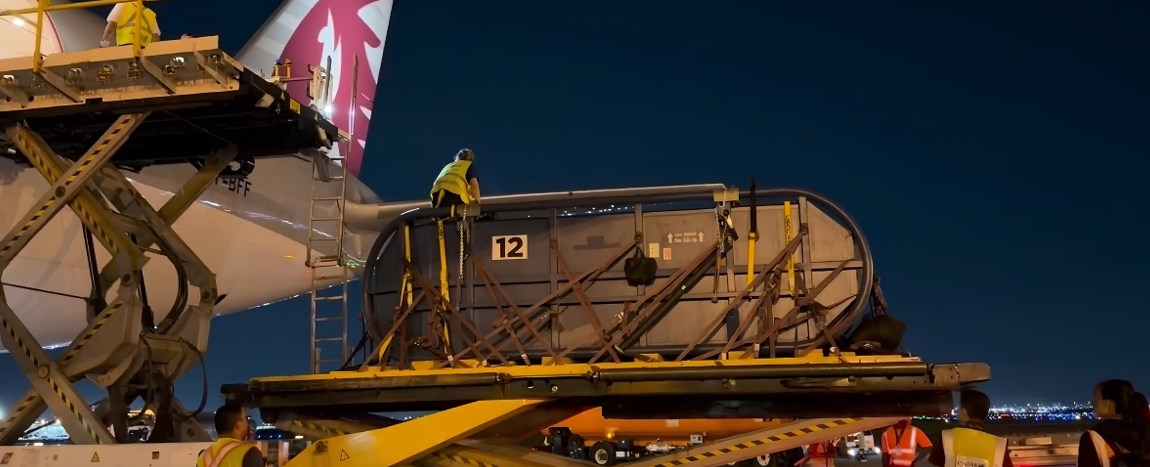
You may have heard: 30 beluga whales and four dolphins from Marineland in Niagara Falls, Ont., have been getting moved in stages this summer to new homes in North America and Europe where they can receive specialized long-term care. For every animal travelling by air, their journey includes a connection and takeoff from Pearson – and the team has been more than happy to provide the travellers with the ultimate VIP treatment during the multi-phase rescue and relocation effort.
The effort began in July, when six beluga whales departed for Chicago and San Antonio. As the operation has unfolded, the team at Pearson has helped support multiple movements through the airport, including most recently, on Aug. 26, when two beluga whales and four dolphins started their journeys.
When Tyler Johnston, aviation safety officer, saw his shift schedule for Aug. 26, he knew it wasn't going to be a typical day.
"I was checking my work email the night before and I'm like, 'Oh, I'm going to be doing whale things.'"
For Tyler, who has spent years working around aircraft, emergency responses and airside operations, the assignment still stood out.
"I've done 100 different fire alarms at this point, and I've helped contain countless animals in and around planes," he said. "But, you know, I've never helped move a whale."
The unusual assignment also led to plenty of happy joking among the team.
"Our passengers are whales today," Tyler recalled. "I can only assume their passport pages are waterproof."
More than moving cargo
Behind the scenes, the relocation effort is a carefully coordinated operation involving veterinarians, animal care specialists, cargo operators, transportation partners, security teams, airport employees and many other organizations working toward the same goal.
The Pearson team has been there to create and maintain the ideal conditions for smooth, fast transport, allowing the animal care experts to do their work safely and efficiently.
"We had to essentially create the safest bubble for the professionals and the animals themselves," Tyler said. "Being the aviation people that they needed."
That effort began hours before the whales arrived. Roads were cleared, traffic routes planned, and equipment positioned to ensure a smooth journey from truck to aircraft. Animal welfare guided every decision, and airport teams even marked pavement edges and potential bumps to help make the trip as smooth as possible.
"We made sure the truck drivers had nothing to worry about other than the smoothest, nicest turns," Tyler said. "Nothing to make this stressful for the animals at all."
For Adam Moyles, manager of airside ground operations, the scale of the operation stood out just as much.
"It was kind of wild — there were about 80 people moving six animals," he said.
Despite the number of organizations involved, the movement unfolded with remarkable efficiency.
"There was definitely a time constraint because you had to move quickly, but still safely," Adam said. "As one animal was being loaded onto an aircraft, the next truck was already backing in to where it needed to go."
He described the operation as "synchronized chaos" — the kind of environment that operations teams thrive in.
Everything was ready before the animals arrived, including the dedicated Qatar Airways Cargo Boeing 777 freighter that carried the belugas, dolphins, animal care teams and specialized equipment to the next stage of their journey.
And while the trucks, aircraft and equipment were impressive, it was the people who stood out.
The people behind the mission
While the whales may have captured everyone's attention, both Tyler and Adam say the real story is also about the people who came together to support the mission with a level of care that extended well beyond the airport ramp and continued throughout the flight itself.
"Sometimes you sit here in bewilderment," Tyler said. "When you think about what we're doing, we're taking a couple of marine mammals, we're putting them in a fish tank, we're putting them in a flying cigar tube, taking them across an ocean."
"Just them," Tyler said, "and then all the support equipment that they required, all the personnel. I saw guys gearing up in wetsuits who were basically going to be in the water with them for the whole flight."
The operation left Tyler with a newfound appreciation for the people responsible for transporting marine animals.
"If I ever need to move my home aquariums, I'm finding these people," he joked.
Veterinarians. Animal care experts. Airline employees. Cargo handlers. Transportation companies. Airport staff. Safety officers. Security teams.
"Everyone had a different golf shirt with a different acronym on it," Tyler said. "It makes you realize, 'Oh, there's a lot more to this.’”
For him, one of the most rewarding parts of the experience was seeing so many different organizations align around a common purpose.
"It's really rewarding to see that many different pieces of different things all just come together and work."
Tyler also believes the operation highlighted one of Pearson's greatest strengths: people who know how to solve unusual problems.
"We really know this place, the ins and outs," he said. "So when people bring us challenges like this, we know how to make it work."
That expertise helped airport teams remove obstacles and create room for specialists to focus on caring for the animals.
"They had everything so dialled in that they just needed us to do the airport part for them."
The result was a true collaborative effort.
"What do you guys need from us? How can we as the GTAA make this as easy as possible?" Tyler recalled. "Whatever you need, we can get it and make it work."
For all the planning, logistics and specialized equipment involved, Tyler says the mission never lost sight of its purpose.
"To actually see them get out of there and go to a much better place," he said, "it's nice to feel part of a rescue mission."
Adam saw the same spirit reflected across the airport community.
"We all have different needs in our job and different goals and tasks we have to achieve," he said. "But we worked together to make this happen successfully."
For him, operations like this are a reminder of what makes Pearson special.
"The true sense of airport community comes out in events like this."
And while most people watch aircraft arrive and depart each day without thinking twice about what's on board, Tyler says this experience gave him a different perspective.
"We see so many planes, you forget what's in them," he said. "Sometimes, it's whales."
Editor's note: While this story was written, one of the beluga whales from the first transport died about two weeks after arriving at its destination in Chicago. While the loss is deeply disappointing, it does not take away from the care, coordination and professionalism demonstrated by airport employees and partners who supported the relocation operation.